Cart 0

Table of Contents
Introduction
What was found at Akrotiri did not immediately look like a typical archaeological discovery. As excavations progressed, it became clear that this was not a collection of ruins scattered by time. Instead, an entire prehistoric town began to appear, preserved beneath layers of volcanic ash.
Streets followed their original paths. Buildings stood where they had been left. Objects remained inside rooms, offering a rare sense of continuity between past life and present observation.
A Town Preserved Beneath Volcanic Ash
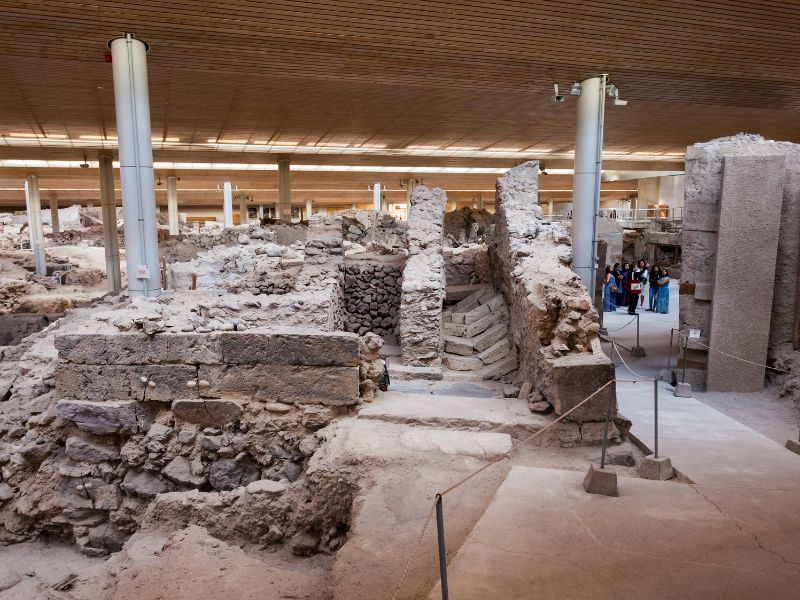
One of the most striking things found at Akrotiri is the way the town survived. The volcanic ash did not flatten the settlement. It settled gradually, covering structures and sealing them in place.
Because of this, walls, floors, and interior spaces remained intact for centuries. When archaeologists began uncovering the site, Akrotiri emerged as a town with clear structure rather than fragmented remains.
Houses, Streets, and Multi-Storey Buildings
Among the most revealing elements found at Akrotiri are the buildings themselves. Excavations uncovered paved streets, closely arranged houses, and multi-storey structures rising two or even three levels high.
These were not isolated constructions. Buildings were connected and organized into neighborhoods, suggesting a community shaped by daily movement and shared activity rather than monumental display.
Wall Paintings and Everyday Objects
Some of the most vivid discoveries found at Akrotiri come from inside the buildings. Wall paintings appeared on interior walls, depicting natural scenes, human figures, and maritime life.
Alongside these images, archaeologists uncovered pottery, tools, and storage vessels. These objects were not symbolic offerings. They were practical items, left behind in spaces where everyday life once unfolded.
Notable Discoveries of Akrotiri
Certain finds help define how the site is understood today.
The Spring Landscape fresco, with its lilies, swallows, and rocky terrain, shows a close observation of nature that feels unusually immediate. The Flotilla Fresco, depicting ships moving between coastal settlements, suggests travel, trade, and connection across the Aegean.
Large storage jars and household tools were also found exactly where they had been used, reinforcing the sense that the town paused rather than collapsed.
What Was Not Found at Akrotiri
Just as important is what was not found at Akrotiri. No human remains were discovered anywhere within the settlement.
This absence strongly suggests that the inhabitants left before the eruption reached its most destructive phase. Akrotiri tells a story of departure rather than sudden disaster.
Why What Was Found Matters
What was found at the archaeological site of Akrotiri changed how prehistoric life in the Aegean is understood. The discoveries point to a society that was organized, expressive, and closely connected to the sea.
Rather than a simple settlement, Akrotiri emerged as a complex town with planning, continuity, and a strong sense of place.
Reading Akrotiri Through Its Discoveries
What was found at Akrotiri does not speak loudly. It reveals itself through layout, repetition, and everyday detail.
Walking through the site today means moving through spaces that were once lived in and then quietly left behind. That sense of proximity is what makes Akrotiri feel less like a distant ruin and more like a town momentarily paused in time.