Cart 0

Table of Contents
Introduction
Akrotiri is often called the Pompeii of the Aegean, a phrase meant to explain—quickly—why this prehistoric site on Santorini feels different from most archaeological places in Greece. The comparison is useful, but only up to a point.
To understand Akrotiri properly, it helps to know what this label really refers to, and what it leaves out.
A Town Preserved by Volcanic Ash

The comparison begins with the eruption. Like Pompeii, Akrotiri was covered by volcanic ash that sealed the settlement instead of erasing it.
Ash settled gradually over buildings, streets, and interiors. This slow burial protected walls, floors, and objects from weather and later disturbance. When excavations started, archaeologists did not find isolated remains, but a town whose structure could still be traced.
That level of preservation is rare. It is also the main reason the Pompeii comparison exists at all.
What Akrotiri and Pompeii Truly Have in Common
Calling Akrotiri the Pompeii of the Aegean reflects a shared quality rather than a shared appearance.
Both sites reveal:
towns preserved rather than rebuilt,
spaces shaped by daily routines,
urban layouts that can still be followed on foot.
In both cases, visitors move through places that once functioned normally, without having been redesigned for later generations.
Where the Comparison Breaks Down

Despite the shared idea of preservation, Akrotiri and Pompeii are very different experiences.
At Akrotiri:
no human remains were uncovered,
the settlement belongs to a much earlier prehistoric world,
the site is enclosed and calm rather than open and dramatic.
These differences matter. Akrotiri does not present frozen moments of disaster. Instead, it presents absence, structure, and continuity.
Why the Label Can Mislead Visitors
The phrase Pompeii of the Aegean can create expectations that Akrotiri does not try to meet.
Some visitors arrive expecting:
scenes of sudden destruction,
figures caught in motion,
imposing Roman-style architecture.
What they find instead is quieter. The story here is not about collapse, but about departure and preservation.
What the Comparison Is Actually Useful For
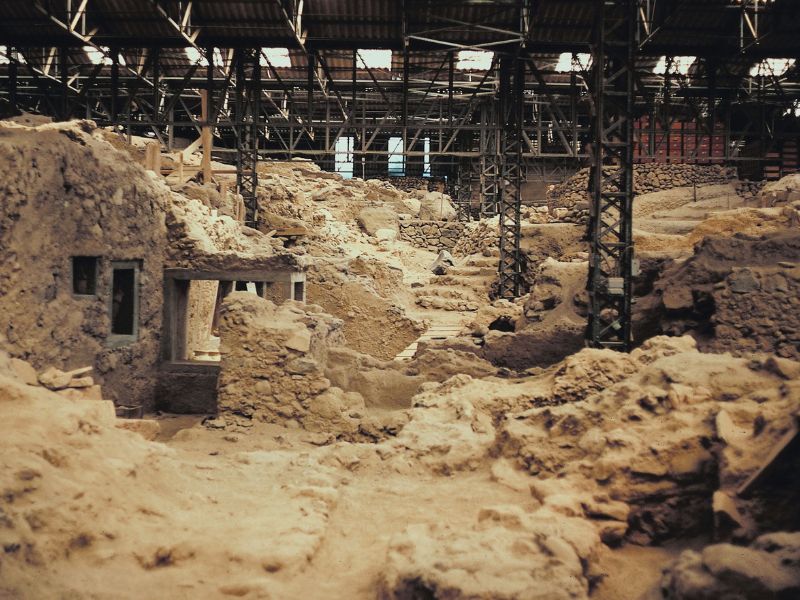
Used correctly, the comparison helps visitors understand one thing: Akrotiri is exceptionally well preserved.
It signals that this is not a hill of ruins or a symbolic monument. It is a place where layout, movement, and everyday space still matter.
Beyond that, the label should be set aside.
Understanding Akrotiri Beyond “ Pompeii of the Aegean ”
The term Pompeii of the Aegean works best as a starting reference, not a definition. It explains why Akrotiri is important, but not how it feels.
Akrotiri stands on its own—as a prehistoric town preserved through time, not through drama. Visitors who move past the comparison often discover a site that feels quieter, more reflective, and unexpectedly human.